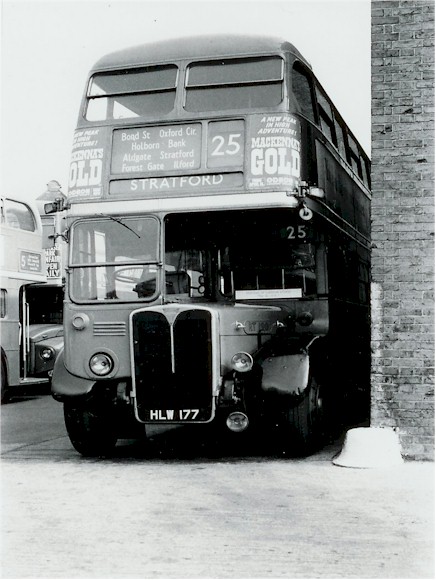
RT1173 (JXC 481) out of Rye Lane
Garage pictured outside Peckham Bus Garage. ©unknown; kindly supplied by Chris
Stanley.
RT1173 (JXC 481) out of Rye Lane
Garage pictured outside Peckham Bus Garage. ©unknown; kindly supplied by Chris
Stanley.London Transport RT - RT190 History
The
reader will be aware that generally it is the chassis/engine manufacture that
governs the brand (identity) of a bus. E.g.
it is an AEC RT not a Park Royal (or Weymann) RT etc..
However in the case of this particular RT (RT190) the body has determined
the identity of the RT and not the chassis or engine!
Here’s
the story:
RT190
(HLW 177) was part of the first batch of RT3s bodied by Park Royal (body number
1439) and taken into stock by London Transport on October 3rd
1947. It
was delivered to Leyton Garage primarily to replace the open staircase LT type
6-wheeler buses that mainly operated on the 10, 35 and 38 routes radiating out
into the Essex countryside (principally Epping Forest).
On
May 13th 1949, RT1173 (JXC 481) with a Saunders Engineering Shipyard
Ltd. (of Beaumaris, Angelsey) body (numbered 2452) was also taken into stock by
LT and delivered to Elmers End Garage.
RT1173 (JXC 481) out of Rye Lane
Garage pictured outside Peckham Bus Garage. ©unknown; kindly supplied by Chris
Stanley.
JXC 481 was overhauled twice, once at Chiswick in 1953, following which it was sent to the Old Kent Road Garage, and later at Aldenham in May 1957. During its latter overhaul, a body-swap took place whereby the body of RT190 (PRV body number 1439) was fitted to RT1173. This vehicle then entered service at Forest Gate garage and subsequently, from June 1960, at the Rye Lane garage where, due to then having an old (RT3) body, it was withdrawn from service early, in December 1962. Although it did not actually leave Rye Lane Garage until April 1963 when it was sold to the dealer, Arlington Motors of Potters Bar, from where it was onward sold to Ubique Coaches (North London) where it continued in service until 1970 when it was sold for preservation becoming part of the then Cobham Bus Museum collection
In the meantime, the older RT190 (HLW 177) with its then newer Park Royal body [see Note 2] (LT number 4875), acting for sometime as a driver trainer vehicle, lasted at West Ham Garage until being withdrawn in October 1969 to be onward sold in January 1970 to S. Eynon, Trimsaran, Carmarthenshire.
 as it was at West Ham garage in 1968/9. "Thumbnail image of the LT RT190 (HLW 177) as it was at West Ham garage in 1968/9. Click here for a larger image that will open a new window.") The
RT190 (HLW 177) with its Park Royal body L1035 (LT fleet number 4875).
The
RT190 (HLW 177) with its Park Royal body L1035 (LT fleet number 4875).
Since
it was impractical to preserve RT1173 in an “as delivered” condition [see
Note 1] it was
decided to re-register RT1173 with the older, and since scrapped, RT190
registration HLW 177 and preserve the features of the earlier RT3 body.
Thus PRV body (number 1439) was “reunited” with RT190 (JXC 481)
albeit on a later 1949 chassis.
 Here is RT190 (registered as JXC
481) with its PRV body (number 1439) pictured in 1974 at the Southend Rally by
©Michael
Clarke, and
kindly sent in by Chris
Stanley.
Here is RT190 (registered as JXC
481) with its PRV body (number 1439) pictured in 1974 at the Southend Rally by
©Michael
Clarke, and
kindly sent in by Chris
Stanley.
 The RT3 (HLW 177) with its PRV 1439 body.
 And
pictured here at Green Park on October
28th '06, the last day of Routemasters and Crew Operation on Route 38, the same
route on which RT
190 began in the Autumn of 1947.
And
pictured here at Green Park on October
28th '06, the last day of Routemasters and Crew Operation on Route 38, the same
route on which RT
190 began in the Autumn of 1947.
Since
then, almost everything has been retrofitted to the “as delivered” RT3
condition that has included the following (but this is not an exhaustive list):
the removal of saloon heaters;
the removal of the rubber mat for the platform (original oak planking being refitted);
the front bulkhead rexine replaced with the original linoleum;
the destination boxes masked as per wartime/immediate post-war requirements;
the upper deck window surrounds and waistrail painted in “Chiswick Cream”;
replacement of the blackout warning circle on the lower deck rear panel (as per the original specification despite hostilities having ceased for over two years prior to 1947);
the reapplication of LPTB legal lettering LTE being the owning authority from January 1st 1948 (only 200 RTs had ever received this).
Some
features of RT1173 have been retained (though not as per original RT190 “as
delivered” specification) such as:
front “ear” trafficators;
rear reflectors that were fitted to all buses from 1958 onwards;
rear Routemaster type trafficators/lights that were fitted to all RT3s from around 1963;
route stencil plate on rear offside (staircase) panel;
and the pre-war “STL-type” headlamps that were still extant on RT1173 were kept as they were also fitted to the very first post war RTs (presumably to use up pre-war stock).
[Note
1]
The RT3 bodies differed from all other
post war RT bodies in that they could not be inter-mixed with Leyland (RTL)
chassis. The Leyland RTL chassis had larger dumbirons which were not
compatible with RT3 bodies. Later bodies could be fixed to either AEC (RT) or
Leyland (RTL) chassis.
This page by Dean Jones.
[Note 2] Previously this text indicated that the older RT190 (HLW 177) had a Saunders body. Brian Watkinson has advised that RT190 never had a Saunders body, it always had a PRV body albeit of different styles.
[Note 3] The text here indicates that this is not an exhaustive list however Brian Watkinson points out that originally RT190 would have had green marble effect rubber sheet on the front bulkhead (rexine was never used at this location) and coving panels. Upon overhaul, this would have been replaced by khaki linoleum or painted over.